

Highlights:
- 100% owned 35,705 ha advanced exploration project in the eastern Athabasca Basin; acquired from Denison Mines, a key shareholder with CEO David Cates on Skyharbour’s board
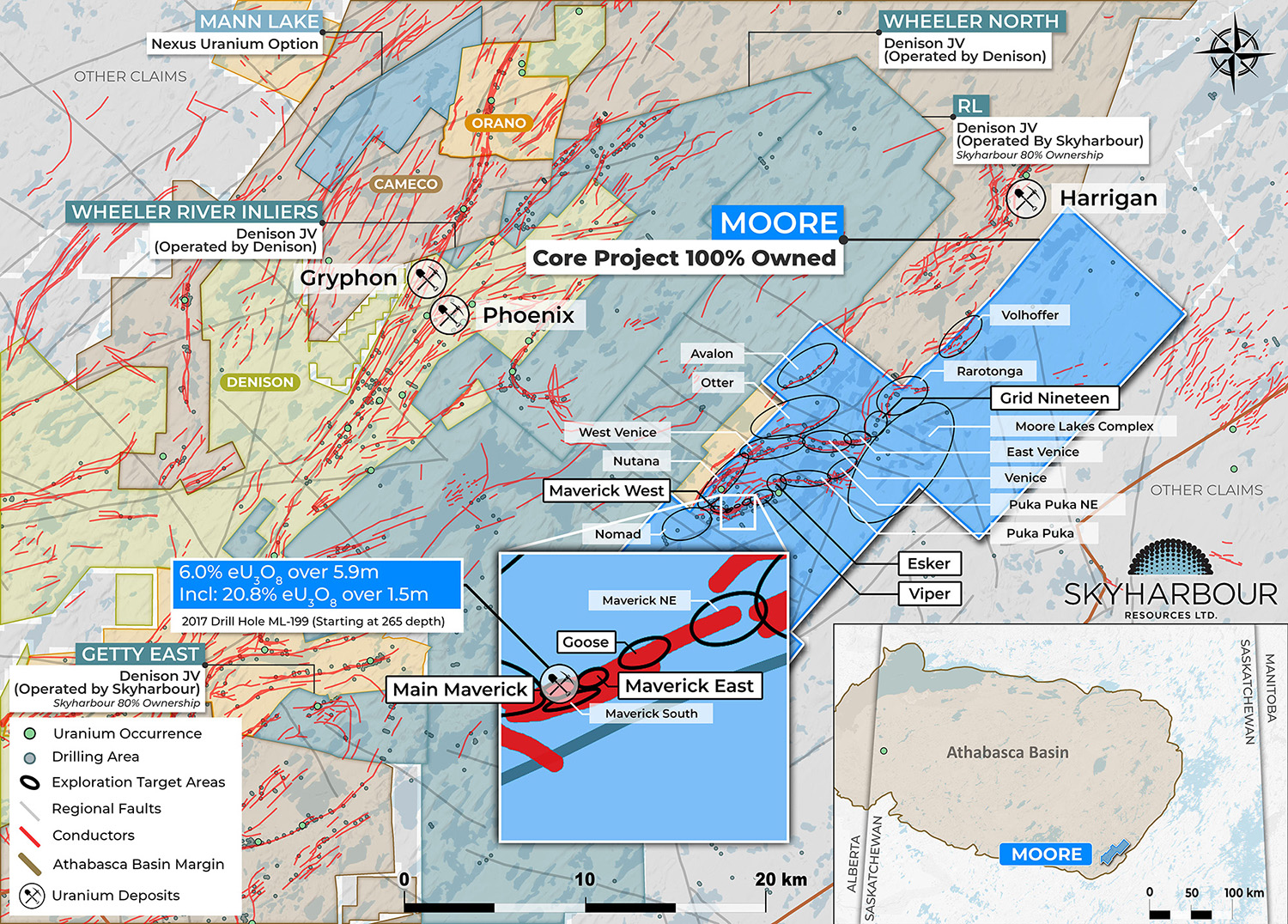
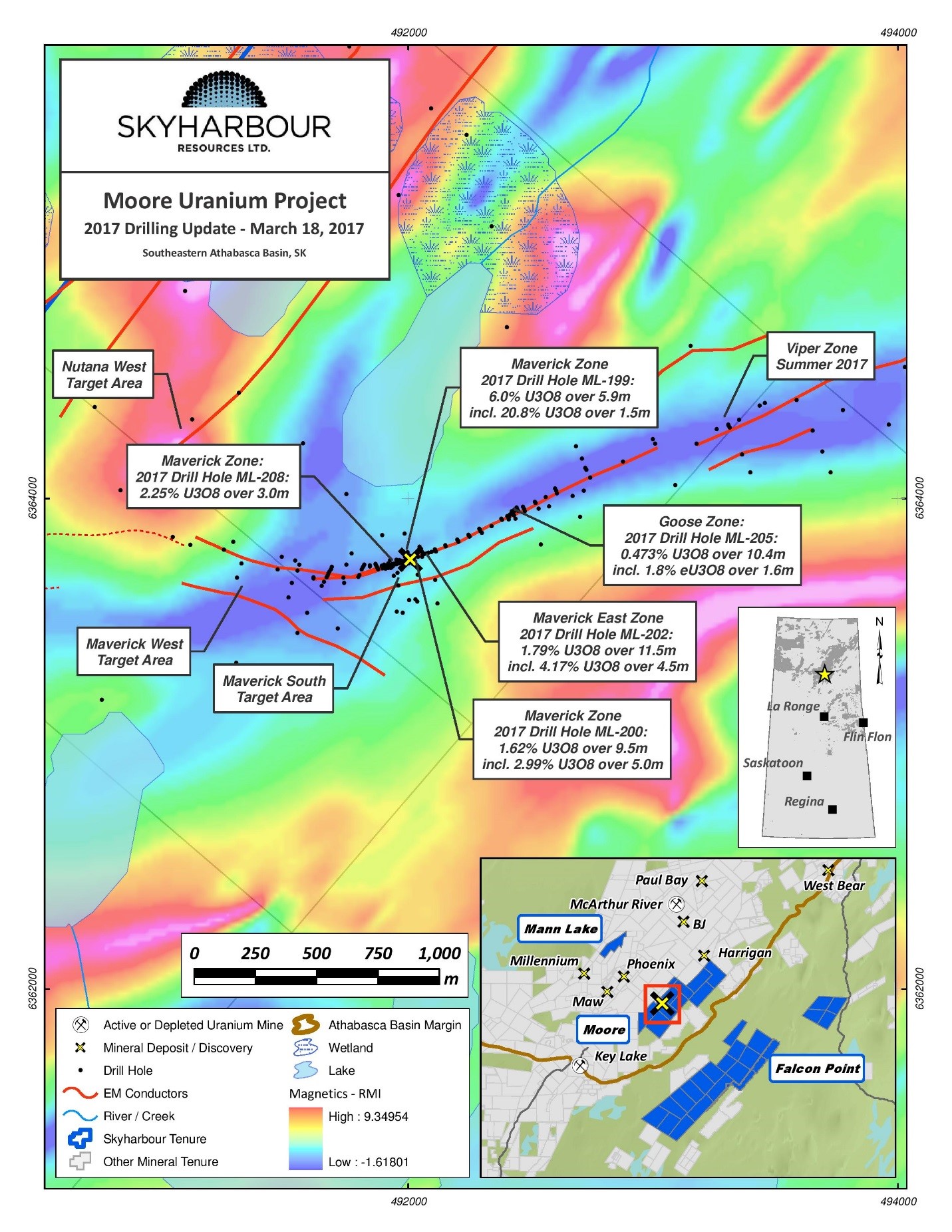
- Hosts high-grade uranium at the Maverick corridor, with standout drill results including 20.8% U₃O₈ over 1.5 m, 9.12% U₃O₈ over 1.4 m, and 1.79% U₃O₈ over 11.5 m including 4.17% over 4.5 m
- Discovery of multiple high-grade lenses at Maverick and Maverick East highlights strong potential for additional zones along strike and at depth in basement feeder structures
- Extensive historical work: $45M in exploration, 150,000+ m drilled across 390+ holes; only 3 km of the 4.7 km Maverick corridor systematically tested no deeper than the unconformity
- Ongoing exploration success with 2020–2025 drill campaigns, including regional targets (Grid Nineteen, Viper) and high-grade intercepts at Main Maverick and Maverick East Zones
- Recently completed 2025 drill program to expand Maverick Zones and test priority regional targets
- Skyharbour plans to carry out a multi-phased campaign consisting of 8,000 - 10,000m of drilling in 2026 to follow up on the recent success in 2025
Moore Uranium Project History and Overview:

In June 2016, Skyharbour secured an option to acquire Denison Mine's Moore Uranium Project, on the southeastern side of the Athabasca Basin, in northern Saskatchewan and has fulfilled its earn in. The project consists of 12 contiguous claims totalling 35,705 hectares located 42 kilometres northeast of the Key Lake mill, approx. 15 kilometres east of Denison’s Wheeler River project, and 39 kilometres south of Cameco’s McArthur River uranium mine. Unconformity style uranium mineralization was discovered on the Moore Project at the Maverick Zone in April 2001. Historical drill highlights include 4.03% eU3O8 over 10 metres including 20% eU3O8 over 1.4 metres, and in 2017, Skyharbour announced drill results including 6.0% U3O8 over 5.9 metres including 20.8% U3O8 over 1.5 metres at a vertical depth of 265 metres. In addition to the Maverick Zone, the project hosts other mineralized targets with strong discovery potential which the Company plans to test with future drill programs. The project is fully accessible via winter and ice roads which simplifies logistics and lowers costs, with large proportions of the property are accessible in the summer as well.
Moore Property Location:
Since 1969, the property has undergone episodic exploration by several companies including Noranda, AGIP, BRINEX, Cogema, Kennecott/JNR Resources and IUC/Denison. In April of 2000 the Maverick Zone was discovered and in the fall of 2003, International Uranium Corporation, who then merged with Denison, optioned 75% of the property from JNR and took over operatorship. Subsequently, Denison acquired the remaining 25% interest from JNR for an undivided 100% in February of 2013, when it acquired all of the outstanding shares of JNR. Exploration programs carried out on the project lands include an assortment of airborne and ground electromagnetic and magnetic surveys, ground gravity, seismic, IP/resistivity and geochemical surveys, mapping, prospecting, lake sediment sampling programs and the drilling of more than 390 diamond drill holes. From mid-2000 onwards, the primary focus of exploration has been the 4.7 kilometre long Maverick structural corridor where pods of high grade unconformity-type uranium mineralization have been intersected. The best intercepts to date were obtained from drill holes testing the southwestern portion of this corridor. The potential of intersecting additional mineralization along this corridor is very good and as such it will continue to be a high priority target area. Also of note is that both basement and unconformity-type uranium mineralization have been intersected in a number of underexplored target areas on the property.
In addition to the Maverick Zone, diamond drilling in several other geophysical target areas, has intersected multiple conductors associated with significant structural disruption, strong alteration and anomalous uranium and pathfinder element concentrations. This bodes well for the possibility of discovering additional high grade uranium zones in these areas.
Skyharbour’s former Head Technical Advisor and Director, Rick Kusmirski commented: “I’ve always considered the Moore Uranium Project to be one of the most geologically prospective exploration projects in the Basin, with the potential to host a sizeable high grade uranium deposit. JNR made the initial high grade discovery at the Maverick Zone and after a number of years we sold the project and company to Denison. I am very excited to get back to work on this project with the Skyharbour team. In addition to the Maverick structural corridor, which still has a number of targets that are untested and require follow-up, there are at least nine other target areas throughout the property that contain well defined and extensive conductive systems. The nominal amount of drilling that was carried out in these areas intersected well defined structures associated with multiple graphitic lithologies. Analysis of the drill core returned highly anomalous geochemistry, including uranium mineralization in seven of the target areas.”
2026 Planned Drilling:
In 2026, Skyharbour plans a multi-phased drill program at the Moore Lake Project totaling approximately 8,000 to 10,000 metres, beginning with a winter phase of 5,000 to 6,000 metres. Additional geophysical surveys and fieldwork are currently underway to refine targets ahead of drilling.
The winter program will focus on expansion drilling at the Maverick zones and follow-up drilling at the Esker and Nomad target areas. A ground SWML-TDEM survey is being conducted to extend geophysical coverage approximately 2 kilometres southwest along a structurally controlled corridor defined by historical gravity data and intense alteration at Nomad. Drilling will target priority gravity anomalies, newly identified EM conductors, and the potential northeast strike extension of mineralization at Esker, including follow-up on historical hole ML-165 (1.21% U₃O₈ over 0.5 metres).
2025 Drilling:
News Release - January 14, 2026
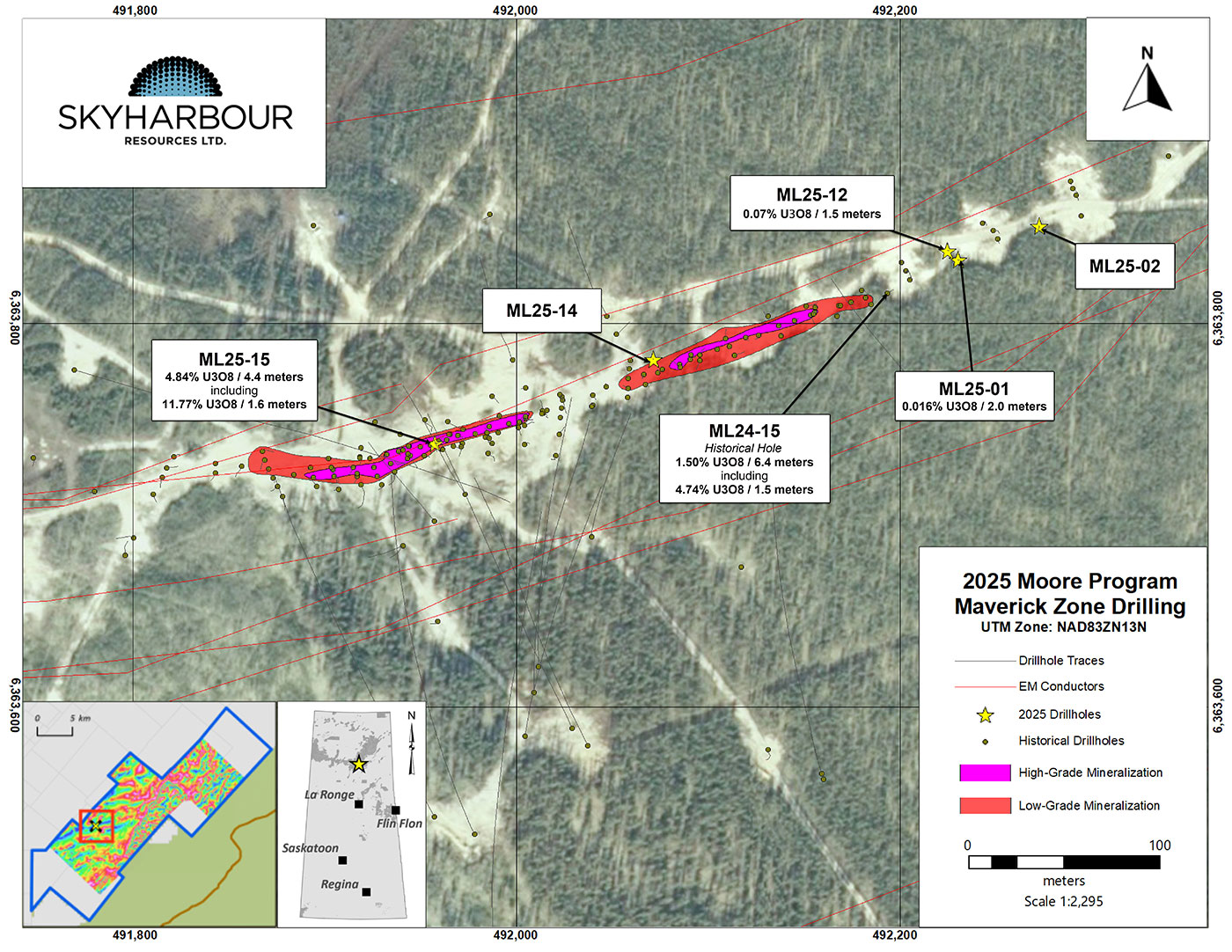
In 2025, Skyharbour completed a 21-hole diamond drill program totaling 7,884 metres at the Moore Lake Project. The program successfully confirmed high-grade uranium mineralization at the Main Maverick Zone, highlighted by hole ML25-15, which returned 4.84% U₃O₈ over 4.4 metres, including 11.77% U₃O₈ over 1.6 metres. In addition, the Company identified a new regional target area, the Nomad Zone, located approximately 1.7 kilometres southwest of the Main Maverick Zone. Initial drilling at Nomad intersected significant sandstone and basement-hosted faulting with intense hydrothermal alteration, outlining a highly prospective setting and reinforcing the potential for further uranium discoveries across the broader Moore Lake property.
Main Maverick and Maverick East Drilling:
2024 Summer Drill Program:
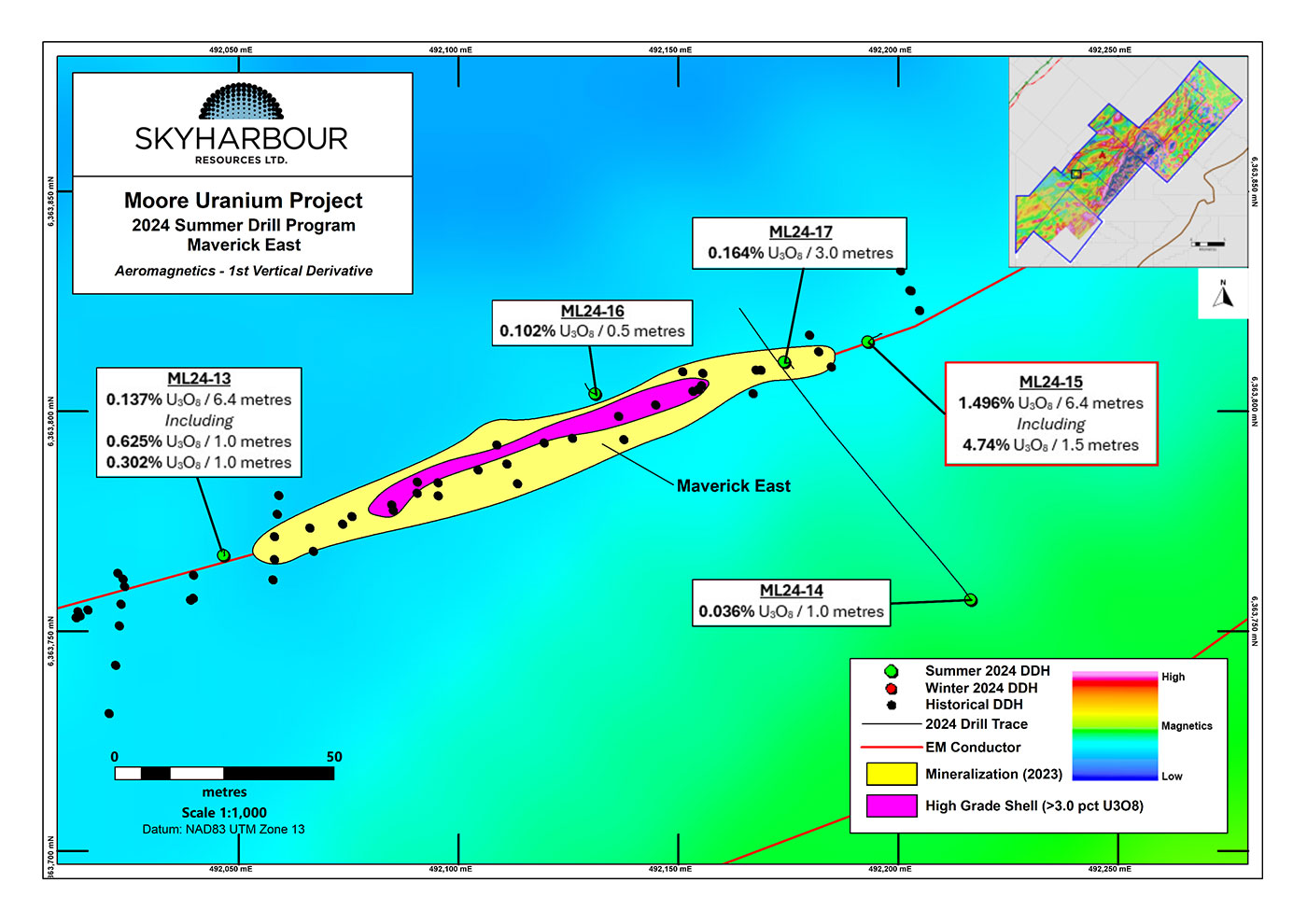
The phase of drilling on the Moore Project later in 2024 totalled 2,759 metres in nine holes. Of the nine holes, four holes (ML24-10 to -12 and ML24-18) focused on the Main Maverick Zone and five holes (ML24-13 to -17) on the Maverick East Zone. The primary objective of the summer program was to extend and expand the boundaries of the Main Maverick and Maverick East Zones with all but one hole successfully intersecting uranium mineralization. Drill hole ML24-15 which intersected 6.4 m of 1.50% U3O8 successfully expands the Maverick East zone over 40 metres along strike to the northeast with more drilling warranted in the area.
2024 Winter Drill Program:
Drilling on the Moore Project over the winter of 2024 totaled 2,864 metres in nine holes. Seven holes (ML24-01 to -04 and ML24-7 to -09) were drilled at the Main Maverick Zone and two holes were drilled on the Grid 19 target conductors (ML21-05 to -06).
Main Maverick Zone Drilling:
Seven holes totalling 2,221 metres were drilled at the Main Maverick Zone to better define and expand the shallow high-grade mineralized zone. All of these holes were drilled vertically and intersected significant uranium mineralization at the unconformity centred around 265.0 metres to 275.0 metres downhole depth. The majority of the high-grade uranium mineralization at the Main Maverick Zone is sandstone-hosted situated just above the unconformity.
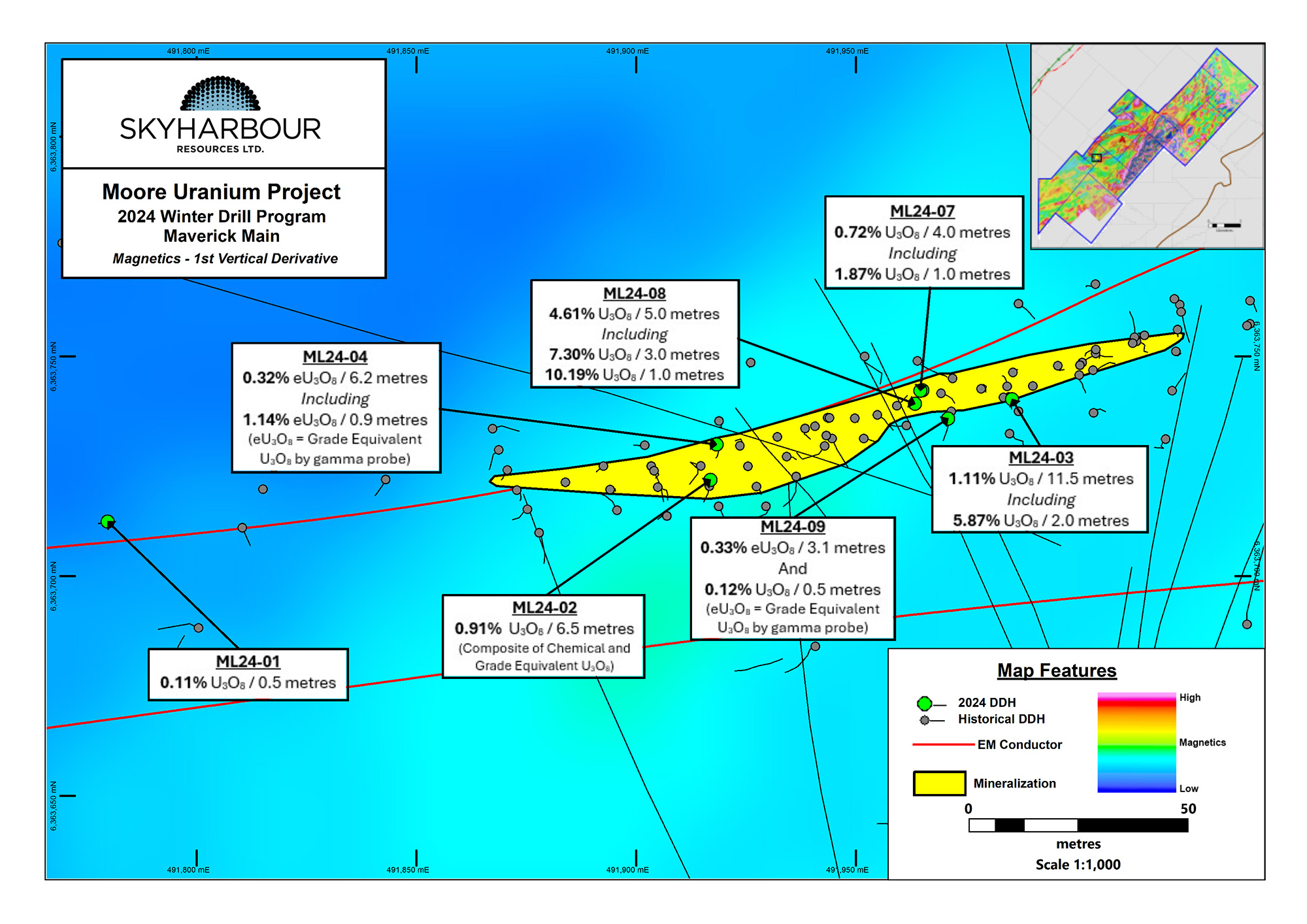
The highlight was hole ML24-08, which intersected 5.0 metres of 4.61% U3O8 between 265.5 metres and 270.5 metres depth including 3.0 metres of 7.30% U3O8 between 266.0 metres to 269.0 metres depth. Another notable hole was ML 24-03, which intersected a broad interval of mineralization grading 1.11% U3O8 over 11.5 metres between 266.8 metres to 278.3 metres depth, including 5.87% U3O8 over 2.0 metres.
Grid Nineteen Drilling:
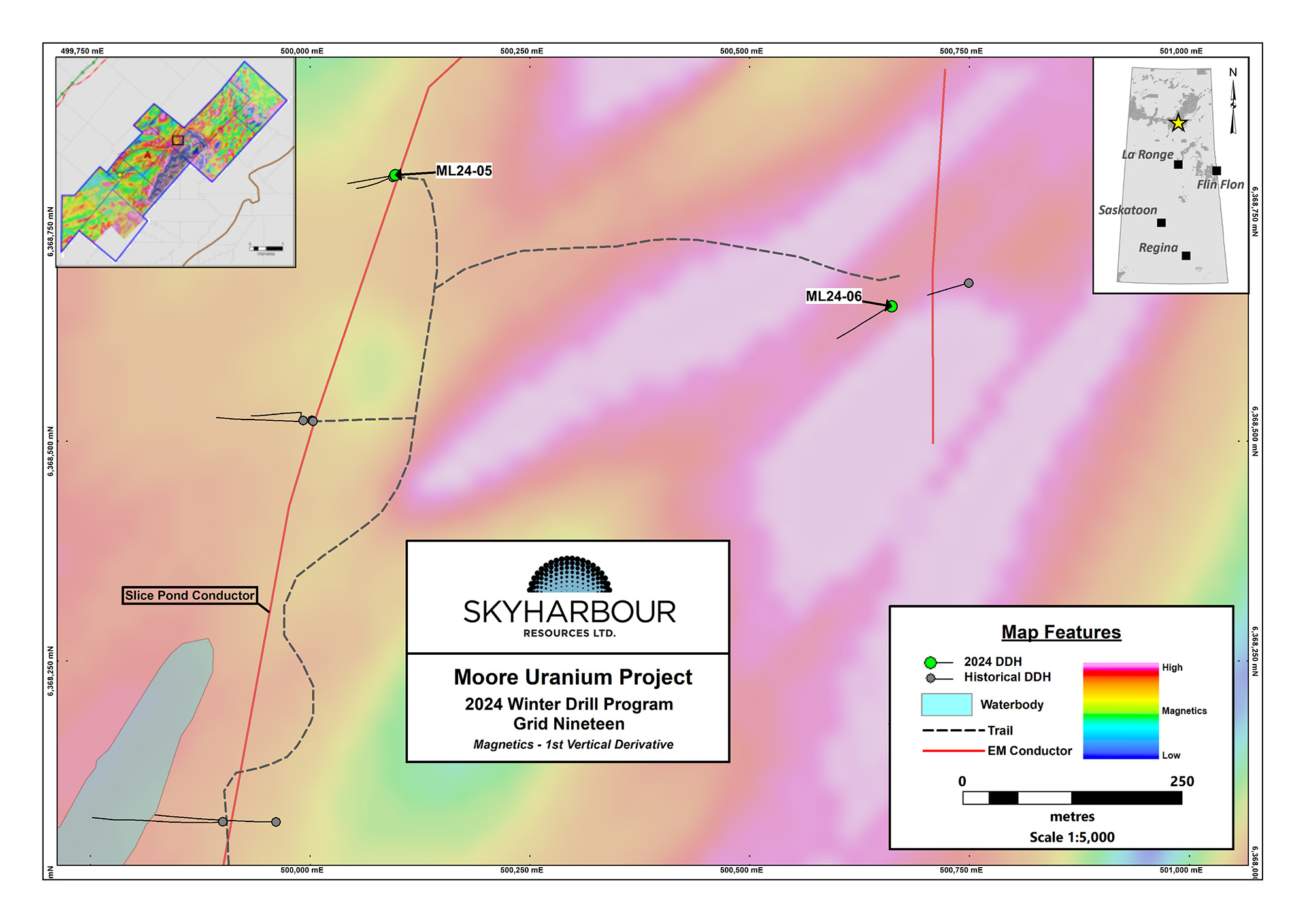
Two exploratory holes totalling 643.0 metres were drilled at the Grid 19 target area approximately 10km NE of the Maverick Zones, with one hole drilled on the Slice Pond Conductor (ML24-05) and the other hole on the 19 East conductor (ML24-06).
Skyharbour's Spring 2022 Drill Program:
News Release - October 13, 2022
Drilling on the Moore Uranium Project over the spring of 2022 totalled 2,467 metres in seven diamond drill holes. Four exploratory holes (ML22-01 to -04) were drilled at the Grid Nineteen target conductors, two exploratory holes (ML22-05 and -06) were drilled in the Viper target area, and one hole (ML22-07) was drilled at the Maverick East Zone.
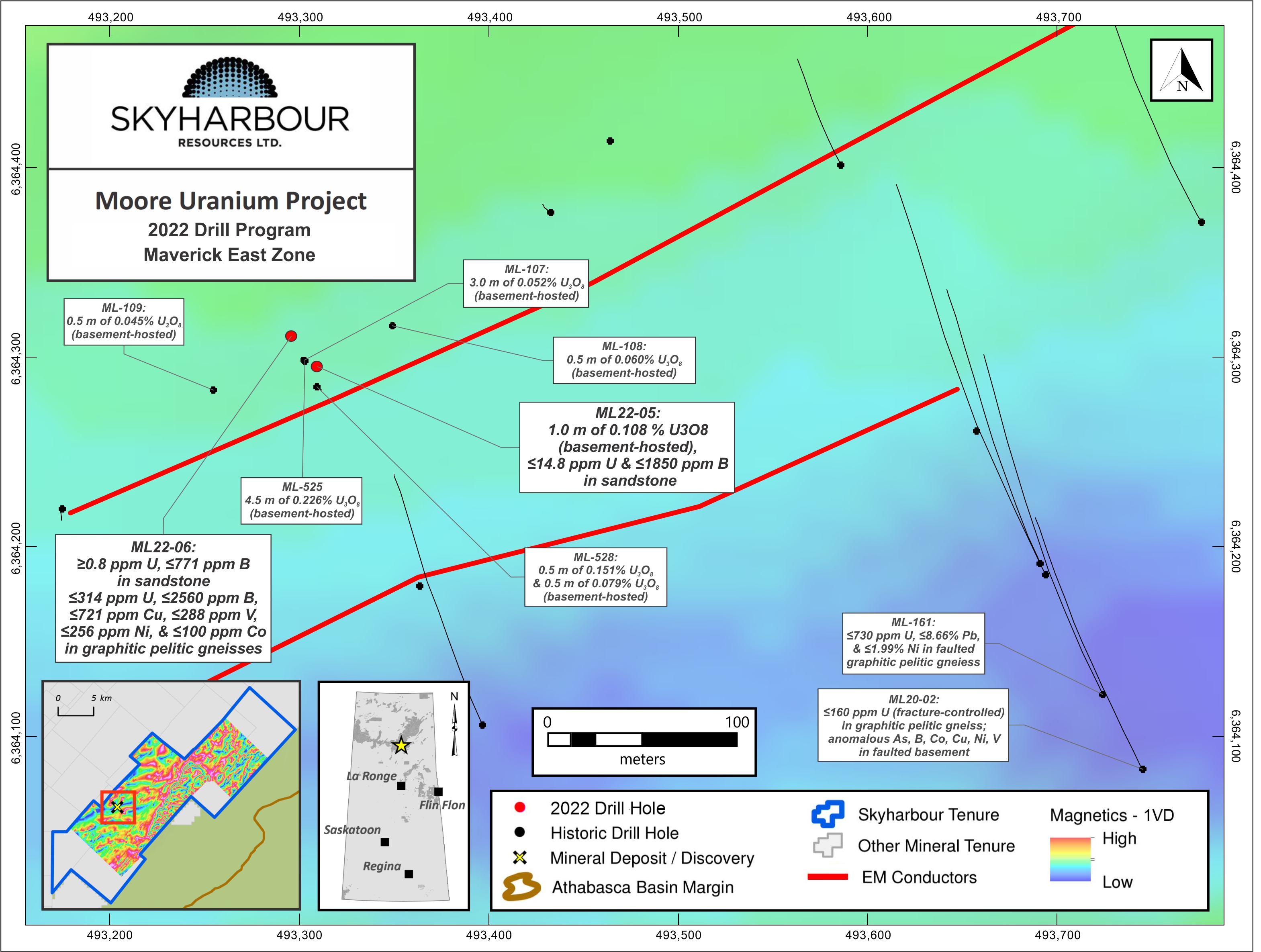
Future drill programs will continue to test targets identified by modelling down plunge of the Maverick East Zone, targets along the Grid Nineteen conductors where anomalous geochemistry and geology have been identified, and test other regional targets at the project where the geochemistry/pathfinders and geology are strongly indicative of potentially uraniferous mineralizing systems.
Terms of the Denison-Skyharbour Option Agreement:
Under the terms of the Option Agreement with Denison, Skyharbour acquired a 100% interest in the Moore Project having issued 4,500,000 shares and having made a cash payment of CDN $500,000 as well as funding CDN $3,500,000 in exploration expenditures. Skyharbour owns 100% of the project currently.