

Project Summary:
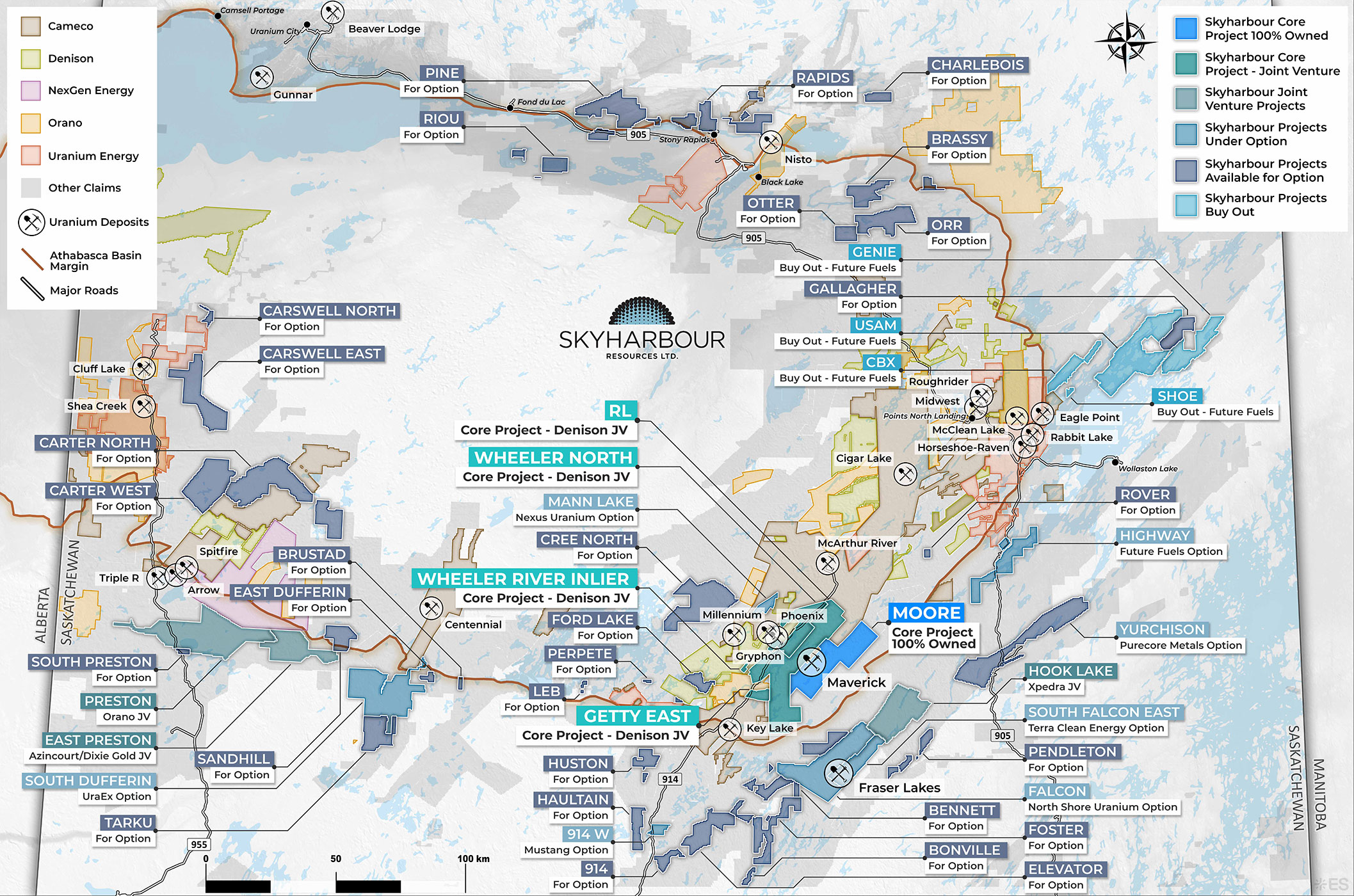
The Pine Project consists of seven mineral claims totaling 23,817 hectares located along the northern margin of the Athabasca Basin. One of the project claims straddles the basin edge, where historical drilling intersected less than 70 metres of Athabasca sandstone, while the remaining claims are underlain by crystalline basement rocks exposed at surface. The property represents a large land package prospective for uranium, gold and base metals.
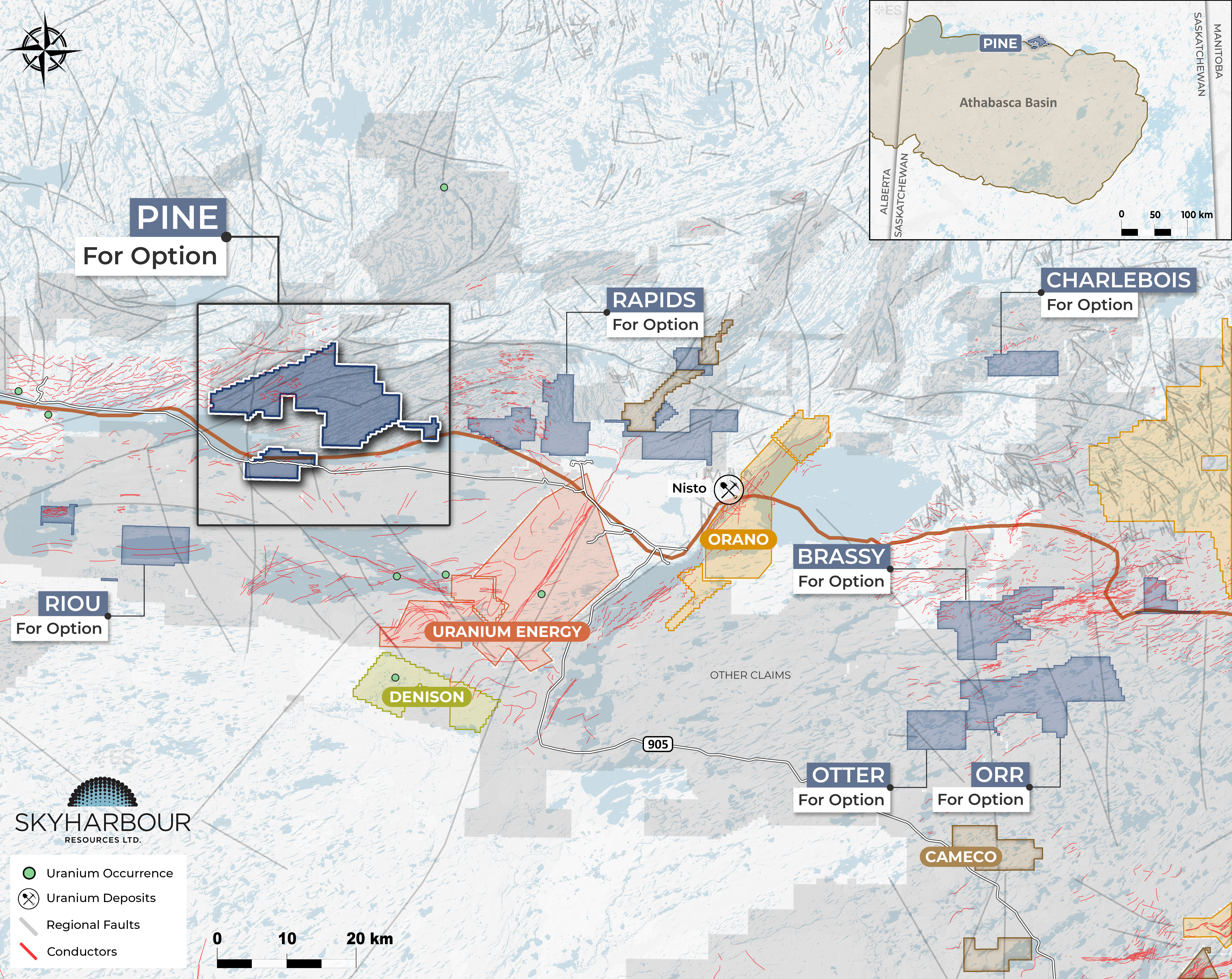
Historical exploration has identified numerous graphitic conductors, regional magnetic lineaments, radiometric anomalies and uranium showings across the property, although much of the area has seen little modern exploration since the early 1980s. Historical drilling completed to test graphitic conductors on the southernmost claim intersected uranium mineralization immediately beneath the Athabasca unconformity, including 0.062% U3O8 over 0.6 metres in drill hole PN-79-2, while subsequent drilling intersected up to 0.150% U3O8 within the overlying Athabasca sandstone. With little to no sandstone cover across most of the property and numerous conductive trends remaining largely untested, the Pine Project offers excellent potential for both basement-hosted and unconformity-related uranium discoveries.
The Pine Project surrounds Eagle Plains Resources’ Pine Channel Project, where historical and recent exploration has outlined a structurally controlled gold system. Several of the principal structural corridors, including the trend hosting the historical G1-G3 gold showing (SMDI 2329) located approximately 500 metres south of the Pine Project boundary, extend directly onto Skyharbour’s claims. Regional geophysical data indicate these structures continue northeastward across the Pine Project, coincident with several conductive trends and historical uranium occurrences.
The broader Pine Channel area hosts numerous historical uranium and gold showings, highlighting the fertility of the regional mineralizing system. Notably, the Varmac uranium veins (SMDI 1578) comprise three parallel pitchblende-bearing fracture and vein systems traced for approximately 120 metres along strike. Historical trenching, channel sampling and drilling returned uranium values including 7.22% U3O8 over 0.9 metres, 0.99% U3O8 over 0.24 metres, 0.45% U3O8 over 0.30 metres, and 0.16% U3O8 over 1.0 metre. Additional nearby gold occurrences include the ELA (SMDI 1574), Algold Bay (SMDI 1575), Thompson Island (SMDI 1576) and PIT (SMDI 1581) showings, which have returned historical drill intercepts of up to 46.9 g/t Au over 3.0 metres and 35.96 g/t Au over 0.55 metres, historical surface samples grading up to 8.22 oz/t Au (approximately 256 g/t Au), and recent grab samples assaying up to 427.0 g/t Au.
With favourable geology, extensive conductive and structural targets, and very limited modern exploration completed over much of the property during the past four decades, Skyharbour believes the Pine Project represents one of the most prospective land packages acquired through its recent staking initiative and an excellent candidate for systematic exploration or advancement through a strategic option or joint venture partnership.
Contact Nicholas Coltura for more details: ncoltura@sentinelmarket.com